
Augmented Reality Knee Replacement in Bangalore
Augmented Reality (AR) technology is revolutionizing the field of orthopedic surgery, particularly in knee replacements. By integrating digital overlays with the real-world surgical environment, AR enhances the surgeon’s precision and decision-making capabilities.
Experience cutting-edge care with Augmented Reality Knee Replacement in Bangalore, where Dr. Ponnanna KM uses advanced AR technology to ensure precise, personalized knee surgery for optimal outcomes.
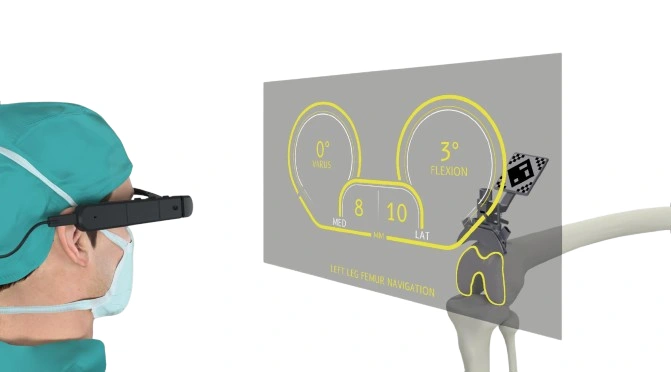
What Is Augmented Reality Knee Replacement Surgery?
Augmented reality knee replacement surgery involves the use of AR technology to assist surgeons during the procedure. AR superimposes digital information, such as 3D models of the patient’s anatomy and real-time data, onto the surgeon’s field of view. This integration allows for enhanced precision and accuracy in aligning and positioning the knee implant. The goal of AR-assisted surgery is to improve outcomes by ensuring the implant is placed as accurately as possible, reducing the risk of complications and enhancing overall joint function.
How Does Augmented Reality Knee Replacement Differ from Traditional Techniques?
Traditional knee replacement surgery relies heavily on the surgeon’s experience and visual cues to position the implant. While successful, this approach has limitations in precision, especially in complex cases. Augmented reality enhances the traditional method by providing real-time, detailed visual guidance. Surgeons can view a 3D model of the patient’s knee, overlaid with critical anatomical landmarks and alignment guides, ensuring optimal implant positioning. This added layer of precision helps minimize errors, improve implant longevity, and enhance patient outcomes.
Why Choose Augmented Reality Knee Replacement Surgery?
– Enhanced Precision: AR technology provides real-time, detailed visual guidance for accurate implant placement.
– Personalized Surgery: Tailored to the patient’s unique anatomy, improving the fit and function of the implant.
– Reduced Surgical Trauma: Minimally invasive approach with potentially smaller incisions and less tissue damage.
– Improved Outcomes: Better alignment and placement of the implant lead to enhanced joint function and longevity.
– Lower Risk of Complications: Increased precision reduces the likelihood of complications such as implant loosening or misalignment.
– Faster Recovery: Patients often experience quicker recovery times due to the minimally invasive nature of the procedure.
– Advanced Planning: Detailed preoperative planning using AR technology ensures optimal surgical strategy.
What Happens During Augmented Reality Knee Replacement Surgery?
During augmented reality knee replacement surgery, the patient is typically placed under general anesthesia or regional anesthesia with sedation to ensure comfort throughout the procedure. The surgery begins with the creation of a detailed 3D model of the patient’s knee using advanced imaging technology. This model is used to plan the precise placement and alignment of the knee implant.
The surgeon uses AR technology to view real-time data and 3D overlays during the procedure. This visual guidance helps the surgeon make accurate cuts and adjustments, ensuring the optimal placement of the prosthetic components. The damaged portions of the femur (thighbone), tibia (shinbone), and patella (kneecap) are removed and reshaped to fit the prosthetic components.
The artificial knee joint, consisting of a femoral component, a tibial component, and sometimes a patellar component, is then implanted. These components are secured in place with bone cement or press-fit to allow the bone to grow into the implant. The surgeon ensures that the new joint is properly aligned and moves smoothly. Once the prosthetic components are in place, the incision is closed with sutures or staples, and a bandage is applied to protect the area.
What Benefits Does Augmented Reality Knee Replacement Offer?
– Increased Precision: Enhanced accuracy in implant placement and alignment.
– Customized Surgery: Tailored to the patient’s unique anatomy.
– Less Tissue Damage: Reduced disruption of surrounding tissues.
– Quicker Recovery: Faster return to normal activities.
– Improved Joint Function: More natural movement and better mobility.
– Lower Risk of Complications: Reduced likelihood of misalignment and other issues.
– Longer Implant Lifespan: Potential for a longer-lasting knee replacement.
– Better Outcomes: Enhanced overall patient satisfaction and quality of life.
How Does Augmented Reality Technology Enhance the Precision of Knee Replacement Surgery?
Augmented reality technology enhances the precision of knee replacement surgery by providing the surgeon with detailed, real-time information and guidance. The use of advanced imaging techniques, such as CT scans or MRI, allows for the creation of a highly accurate 3D model of the patient’s knee anatomy. This model is used to plan the surgery with exceptional accuracy.
During the procedure, the augmented reality system assists the surgeon by providing real-time feedback and ensuring precise cuts and adjustments. This level of precision leads to better alignment and placement of the implant, which can result in improved joint function, reduced risk of complications, and longer-lasting results.
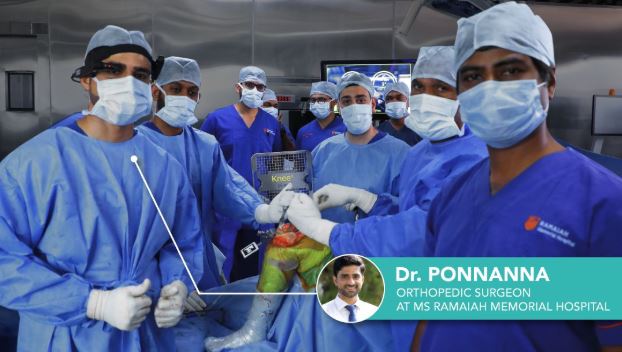
Dr. Ponnanna K.M, an expert in AR-assisted knee replacement, offers personalized care to ensure optimal outcomes. Schedule an appointment at Dr. Ponnanna K.M’s clinic to discuss your options and receive professional advice.
Who Needs Augmented Reality Knee Replacement?
Augmented reality knee replacement is usually considered for people whose knee arthritis has reached a stage where daily life is clearly affected. Typical signs include pain during walking, difficulty climbing stairs, persistent stiffness, and poor relief despite medicines, injections, or physiotherapy. These are also among the common reasons patients are advised to consider knee replacement.
Knee Pain While Walking
If knee pain begins to limit simple activities such as walking inside the house, going to the market, or standing for longer periods, it may indicate advanced joint damage. Patients often say they can no longer walk even short distances comfortably.
Difficulty Climbing Stairs
Climbing stairs is one of the first activities to become difficult when the knee joint is severely worn out. Pain, weakness, and instability during stair climbing are common signs that conservative treatment may no longer be enough.
Stiffness
Morning stiffness, a reduced range of movement, or difficulty bending and straightening the knee can affect sitting, standing, and daily independence. When stiffness continues to worsen, surgery may become the more dependable long-term option.
Failed Physiotherapy
Physiotherapy is an important first step for many patients, but when structured rehab, medications, and injections fail to provide meaningful relief, knee replacement may be the next step. AAOS notes that failure to improve with physical therapy and other non-surgical options is a common reason surgery is recommended.
Internal link placement suggestion:
If your pain is affecting daily movement, you can also read more about knee replacement in Bangalore and when surgery becomes the right option.
Cost of AR Knee Replacement in Bangalore
The cost of augmented reality knee replacement in Bangalore generally depends on the hospital, implant type, surgical complexity, room category, and the technology platform used during surgery. Since AR-assisted knee replacement is an advanced, technology-supported procedure, pricing can vary between centers.
Price Range
A practical patient-facing way to present this is:
Estimated cost in Bangalore: ₹2.8 lakhs to ₹5.5 lakhs per knee
This is a broad estimate and should be presented as an approximate range, since the final quote depends on the patient’s medical condition, implant choice, and hospital package.
What Affects the Cost?
- Type and brand of implant used
- Whether one knee or both knees need surgery
- Hospital category and room selection
- Complexity of deformity or previous surgeries
- Pre-operative investigations and medical fitness workup
- Length of hospital stay
- Rehabilitation and physiotherapy needs
- Use of advanced assistance technology such as AR navigation
You can add a simple line below this section:
For an exact estimate, a consultation and X-ray evaluation are needed before finalizing the surgical plan and implant choice.
Internal link placement suggestion:
Patients comparing options may also want to read about robotic total knee replacement surgery in Bangalore.
Augmented Reality vs Robotic Knee Replacement
A recent 2024 in-vivo study reported that one AR-assisted total knee system showed high accuracy comparable to robotic-assisted total knee arthroplasty. At the same time, evidence reviews note that AR is promising, but long-term outcome data and standardization are still evolving. That means the better option is often not “which technology is newer,” but which one best fits the patient’s knee, the surgeon’s expertise, and the surgical plan.
Feature | Augmented Reality Knee Replacement | Robotic Knee Replacement |
Surgical guidance | Digital overlays guide the surgeon in real time | Robotic platform helps execute the surgical plan |
Accuracy | High accuracy; some studies show results comparable to robotic systems | Strong evidence for precise implant alignment compared with conventional methods |
Equipment footprint | Usually more compact | Usually requires a larger robotic setup |
Surgeon control | Surgeon performs the procedure with AR guidance | Surgeon remains in control, with robotic assistance |
Learning curve | Technology-specific learning curve | Technology-specific learning curve |
Evidence maturity | Promising, but still evolving for long-term data | More established than AR in current mainstream adoption |
Cost | May vary by platform and hospital | Often higher because of robotic platform costs |
Best choice for patients | Depends on anatomy, surgeon preference, and available system | Depends on anatomy, surgeon experience, and hospital setup |
Suggested line below the table:
Both AR-assisted and robotic-assisted knee replacement are advanced options. The right choice depends on your knee damage, deformity, overall health, budget, and your surgeon’s experience with the technology.
Recovery Timeline After AR Knee Replacement
Recovery after AR-assisted knee replacement follows the same general rehabilitation principles as modern total knee replacement. Patients are usually encouraged to start walking early with support, and stair practice often begins in the early recovery phase under supervision. AAOS notes that discharge readiness commonly includes being able to walk with an assistive device and go up and down a few stairs.
Day 1
- Standing and short-distance walking usually begin with walker support
- Pain control and swelling management are started
- Gentle knee bending and physiotherapy exercises begin
Week 1
- Most patients are walking short distances with support
- Knee bending improves gradually
- Stair training may begin in a supervised way, depending on comfort, strength, and balance
Month 1
- Walking becomes more confident
- Many patients can manage basic household movement more independently
- Stair climbing becomes easier, though support may still be needed in some cases
- Structured physiotherapy continues to improve motion and strength
When Can I Walk?
Most patients start walking with support within a day of surgery, depending on their medical fitness, pain control, and the surgeon’s protocol.
When Can I Climb Stairs?
Many patients begin supervised stair practice early in recovery. Comfortable stair climbing improves gradually over the following weeks as strength, balance, and confidence return.
Is AR Better Than Traditional Knee Replacement?
Augmented reality is not a different replacement implant; it is a different way of assisting the surgeon during the operation. Compared with traditional knee replacement, AR aims to improve the precision of bone cuts, implant positioning, and alignment by giving the surgeon real-time visual guidance. Early evidence is promising, but it is best described as an advanced assistance tool rather than a guaranteed “better for everyone” option. Outcomes still depend on correct patient selection, surgical expertise, rehabilitation, and implant choice.
A patient-friendly closing line for this section:
For the right patient, AR-assisted surgery can offer a more technology-guided and highly precise approach, but the best results still come from the right surgeon, the right plan, and proper rehabilitation.
FAQs
What is augmented reality knee replacement surgery?
Is augmented reality knee replacement better than robotic surgery?
Not automatically. A 2024 study found that one AR-assisted system had accuracy comparable to robotic-assisted knee arthroplasty, but current evidence does not support saying AR is universally superior. The better option depends on the surgeon, the platform, and the patient’s knee condition.
Who is the right candidate for augmented reality knee replacement?
The right candidate is someone with severe knee arthritis, knee pain while walking, difficulty climbing stairs, persistent stiffness, or poor relief despite medicines, injections, and physiotherapy. Final suitability depends on clinical examination and imaging.
How accurate is augmented reality knee replacement?
Early published evidence is encouraging. One in-vivo study reported high accuracy with an AR-assisted system, with results comparable to robotic-assisted total knee arthroplasty.
Is augmented reality knee replacement safe?
When performed by a trained orthopedic surgeon in an appropriate surgical setup, AR-assisted knee replacement is considered a safe assistive technology. As with any knee replacement, the overall safety also depends on general surgical risks, infection prevention, anesthesia, and rehabilitation.
How long does a knee replacement last after AR-assisted surgery?
Longevity depends on implant type, alignment, activity level, body weight, bone quality, and long-term care. Knee replacements generally last many years, but AR itself is a guidance tool and does not, by itself, guarantee a fixed lifespan. AAOS notes that knee replacements can last for many years with appropriate activity modification.
Can I climb stairs and sit normally after surgery?
Yes, most patients can return to stair climbing and routine sitting over time, but this happens gradually with physiotherapy and recovery. Stair ability usually returns step by step, and early practice is often supervised.
How do I choose between robotic and augmented reality knee replacement?
Choose based on four things: your knee problem, your surgeon’s expertise, the technology available at the hospital, and your budget. Both robotic and AR-assisted surgery are advanced tools; the best decision is individualized rather than one-size-fits-all.
DR. PONNANNA K.M
Best Orthopedic Surgeon in Bangalore – Specializing in Shoulder, Hip, and Knee Care
Consultant Arthroscopy & Joint Replacement Surgeon
Dr. Ponnanna K.M is an internationally fellowship-trained Orthopedic Surgeon in Bangalore specializing in shoulder, hip, and knee care.
Expert in advanced arthroscopy and joint replacement, he delivers precision-driven, minimally invasive treatments.
Known for accurate diagnosis and patient-first care, he focuses on long-term mobility and pain relief.
Trusted for safe outcomes and surgical excellence.