
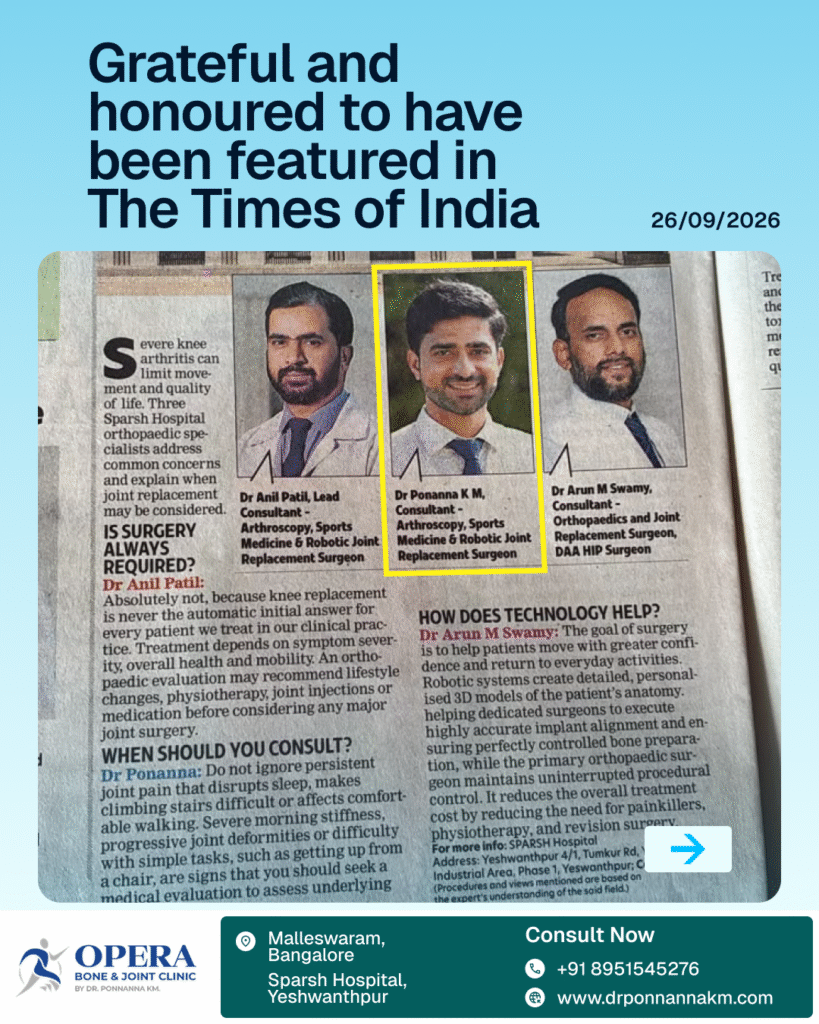
By Dr. Rohit Ponnanna | Orthopaedic & Joint Care, Bengaluru| Times of India
Being featured in The Times of India on 26 September 2026 is a moment I am genuinely honored and grateful for.
For me, recognition in a publication as widely read as The Times of India is not simply about seeing my name in print. It is an opportunity to bring greater attention to conversations that matter to my patients — particularly when it comes to joint health, knee arthritis, pain, mobility and knowing when it is time to seek professional medical advice.
As an orthopaedic professional in Bengaluru, I meet patients from different walks of life who have one thing in common: they want to stay active, independent and able to do the things they enjoy.
Yet, when it comes to knee pain, many people wait.
They wait because they think it is age.
They wait because the pain comes and goes.
They wait because a friend told them that everyone eventually develops arthritis.
They wait because they are worried that seeing an orthopaedic doctor automatically means being told they need surgery.
And sometimes, they wait until something that started as mild discomfort begins to interfere with their everyday life.
That is one of the reasons I believe conversations around knee arthritis and early evaluation are so important.
Why This Recognition Matters to Me
A newspaper feature is meaningful to any professional, but as a doctor, I see it slightly differently.
Every opportunity to discuss healthcare publicly is also an opportunity to improve awareness.
Medical terminology can sometimes make conditions sound more complicated than they are. Patients may hear words such as “osteoarthritis”, “cartilage degeneration”, “ligament injury” or “joint replacement” and immediately assume the worst.
My approach is to encourage patients to understand their condition before worrying about what comes next.
Knee arthritis, for example, is common, but knee pain should never automatically be dismissed as “just arthritis”.
There are several possible causes of knee pain. Osteoarthritis is one of them, but injuries, ligament problems, meniscus issues, tendon conditions, inflammatory conditions and other problems can also produce knee symptoms.
That is why a proper clinical assessment matters.
What Exactly Is Knee Arthritis?
When people talk about “knee arthritis”, they are often referring to knee osteoarthritis– (Times of India)
Osteoarthritis is a condition involving changes to the structures within a joint, including the cartilage. In the knee, these changes can contribute to pain, stiffness, swelling and difficulty with movement.
The symptoms can develop gradually.
You might first notice discomfort after a long walk.
Then stairs become slightly uncomfortable.
Getting up from a chair takes a little more effort.
You may find yourself avoiding certain activities.
Eventually, you realise that your knee has started influencing the way you live your day.
That progression is important.
Knee arthritis does not always announce itself with dramatic pain. Sometimes, the first sign is simply that you are doing less because certain movements have become uncomfortable.
What Are the Common Symptoms of Knee Arthritis?
Some common symptoms associated with knee osteoarthritis include:
- Knee pain, particularly during weight-bearing activities
- Stiffness after periods of inactivity
- Swelling around the knee
- Difficulty climbing or descending stairs
- Difficulty getting up from a chair
- Reduced range of motion
- A grinding or crackling sensation during movement
- Increasing difficulty with walking or exercise
- Pain that gradually becomes more frequent
However, experiencing one of these symptoms does not automatically mean you have osteoarthritis.
The same symptom can occur in different knee conditions.
This is why I always encourage patients to look at the pattern of symptoms, not just one isolated complaint.
When Should You Consult an Orthopaedic Doctor for Knee Pain?
This is perhaps the most important question.
There is no reason to panic every time your knee hurts.
But there is also no benefit in ignoring persistent symptoms indefinitely.
I recommend considering an orthopaedic consultation when knee pain:
1. Keeps coming back
If your knee repeatedly hurts after walking, exercising, climbing stairs or performing everyday activities, it is worth understanding why.
Repeated symptoms deserve attention.
2. Start affecting your everyday activities
This is one of the biggest warning signs I ask patients to pay attention to.
Are you walking less?
Are you avoiding stairs?
Have you stopped exercising?
Are you struggling to get out of a chair?
Are you avoiding outings because you are worried about how much walking will be involved?
When knee pain starts changing your behaviour, it is time to take it seriously.
3. Is accompanied by swelling or stiffness (Times of India)
Occasional discomfort may settle on its own.
Persistent swelling or stiffness, however, deserves an assessment, particularly if there is no obvious explanation.
4. Is getting progressively worse
A knee problem that gradually becomes more frequent or more limiting should not simply be attributed to age.
Understanding the cause can help determine what treatment options may be appropriate.
5. Makes you feel unstable
If your knee feels as though it is giving way or cannot be trusted during certain movements, an orthopaedic evaluation is important.
Instability can have several causes, and the correct diagnosis matters when deciding how to manage it.
Does Knee Arthritis Mean You Need a Knee Replacement?
Not necessarily.
This is one of the first concerns many patients have when they hear the word “arthritis”.
A diagnosis of knee osteoarthritis does not automatically mean that knee replacement is the next step.
Treatment depends on the severity of symptoms, the degree to which the condition affects daily life, clinical findings and the individual’s overall circumstances.
Depending on the patient, management may involve exercise, physiotherapy, activity modification, weight management where appropriate, medication or other non-surgical approaches.
Surgery may be considered for selected patients when symptoms are significant and other treatment approaches have not provided adequate relief.
The important point is that there is no single treatment that is right for every patient with knee arthritis.
The first step is understanding the condition.
Can Knee Arthritis Be Managed Without Surgery? (As mentioned in the Times of India)
In many cases, yes.
Non-surgical management can play an important role in helping people with osteoarthritis maintain movement and function.
Exercise and strengthening are commonly incorporated into osteoarthritis management. Physiotherapy may also help patients improve strength, mobility and function.
The type and intensity of exercise should be appropriate for the individual.
Having knee pain does not necessarily mean that you should stop moving altogether.
At the same time, I would not recommend pushing through severe pain or starting an aggressive exercise programme without understanding what is causing the problem.
The right balance is important.
Why I Encourage Patients Not to Wait Too Long (my viewpoint in the Times of India)
One of the most common patterns I see is a patient adapting their life around their knee.
They stop walking.
They stop playing sport.
They avoid travelling.
They take the lift instead of the stairs.
They stop playing with their children or grandchildren.
They tell themselves that it is simply part of getting older.
But there is a difference between accepting the natural changes that come with age and ignoring a medical problem that could be evaluated and managed.
You do not need to wait until knee pain becomes severe before asking what is happening.
An early consultation does not necessarily mean aggressive treatment.
Sometimes, it simply means getting clarity.
And clarity is valuable.
Knee Health in Bengaluru’s Active Lifestyle
Bengaluru is an active city.
People run, cycle, play badminton, go to the gym, participate in weekend sports, walk for fitness and spend long working days moving between home, office and everything in between.
At the same time, modern working life can involve long periods of sitting followed by sudden bursts of physical activity.
That combination can create challenges for the musculoskeletal system.
For patients in Bengaluru dealing with persistent knee pain, the important thing is not to self-diagnose.
Search engines can tell you what a symptom might mean.
A friend can tell you what happened to their knee.
A social media video can show you an exercise.
But none of these can replace an individual clinical evaluation.
Your knee — and your overall health — is specific to you.
When Knee Pain Needs Urgent Attention
While many knee problems can be assessed through a routine appointment, some symptoms require more urgent medical attention.
Seek prompt medical evaluation if your knee becomes severely painful or significantly swollen, if you cannot bear weight, if the joint changes shape following an injury, or if you are unable to move it normally.
A hot, red and swollen knee, particularly when accompanied by fever or feeling unwell, should also be assessed urgently.
These symptoms should not simply be assumed to represent routine osteoarthritis.
My Message to Anyone Living With Knee Pain (Consult a doctor, as I mentioned in the Times of India)
If there is one message I would like people to take away from this article, it is this:
Do not allow “it’s just age” to become your diagnosis.
Knee pain has a cause.
Sometimes it may be osteoarthritis.
Sometimes it may be an injury.
Sometimes it may be another condition altogether.
The important thing is to understand what is actually happening.
Being featured in The Times of India gives me another opportunity to have this conversation beyond the clinic.
I am grateful for the recognition, but more importantly, I am grateful for the opportunity to continue speaking about something that directly affects people’s quality of life: their ability to move.
For me, orthopaedic care is ultimately about more than treating a scan or managing a joint.
It is about helping people understand their condition, make informed decisions and work towards maintaining the mobility and independence that matter to them.
So, if your knee has been hurting for a while, if you are repeatedly experiencing swelling or stiffness, or if you have gradually started avoiding activities you once enjoyed, consider getting it assessed.
You don’t have to wait until you cannot walk.
Listen to your knees. Understand the problem. And seek the right advice when you need it.
Frequently Asked Questions About Knee Arthritis (yes, in the Times of India)
What are the early signs of knee arthritis?
Early symptoms can include knee pain, stiffness, swelling, difficulty with stairs, discomfort after prolonged sitting and reduced ability to perform activities that were previously comfortable.
When should I see a doctor for knee pain?
Consider consulting an orthopaedic doctor when knee pain persists, repeatedly returns, worsens over time or starts interfering with walking, exercise, stairs, sleep or everyday activities.
Does knee arthritis always require surgery?
No. Many patients can initially be managed with non-surgical approaches such as exercise, physiotherapy, activity modification and other treatments appropriate to their condition. Surgery is considered in selected circumstances.
Can walking help knee arthritis?
Appropriate physical activity can be beneficial for people with osteoarthritis. However, the amount and type of activity should be appropriate for the individual’s symptoms and diagnosis.
How do I know if my knee pain is arthritis?
You cannot reliably diagnose arthritis based on symptoms alone. Knee pain has multiple possible causes, so a clinical assessment may be necessary to determine the underlying problem.
Is knee arthritis only seen in older people?
Osteoarthritis becomes more common with age, but knee problems can occur in younger people as well, particularly in association with previous injuries and other risk factors. Age alone should not be used to diagnose the cause of knee pain.
When is knee pain an emergency?
Severe pain, significant swelling, deformity, inability to bear weight, inability to move the knee, or a hot/red swollen knee accompanied by fever or feeling unwell warrants prompt medical assessment.
About Dr. Rohit Ponnanna
Dr. Rohit Ponnanna is an orthopaedic professional in Bengaluru with an interest in helping patients understand and manage musculoskeletal and joint-related problems. His approach focuses on informed evaluation, appropriate treatment and helping patients work towards maintaining mobility and quality of life.
For consultation and clinic information, patients should contact the practice directly and confirm current appointment availability and services.
This article is intended for general health education and does not replace an individual medical consultation, diagnosis or treatment plan.
Knee Arthritis, Knee Pain, Osteoarthritis, Dr Rohit Ponnanna, Times of India, Orthopaedic Doctor Bangalore, Knee Specialist Bangalore, Knee Pain Treatment, Knee Replacement, Joint Health, Arthritis Treatment, Orthopaedics Bengaluru