
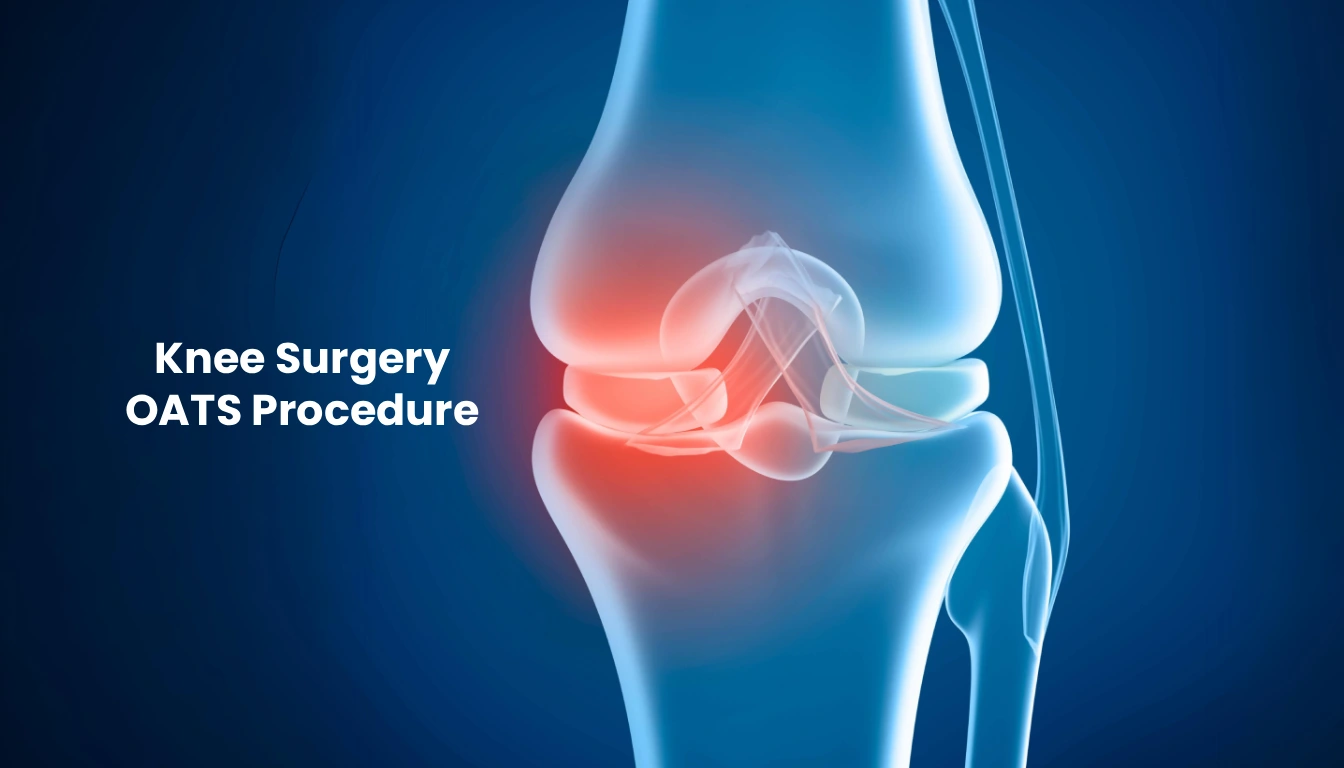
Many people with knee pain are told it’s “wear and tear.” But that explanation doesn’t always fit—especially if you’re younger, active, play sports, or your pain began after an injury. In these cases, the real issue can be cartilage damage (a smooth surface inside the knee that helps the joint glide). The challenge is that cartilage has very limited healing ability. So even after rest, physiotherapy, and medication, the pain, swelling, catching, or “giving way” may continue.
That’s where advanced cartilage repair surgeries come in. One well-established option for the right patient is the knee surgery OATS procedure, a technique designed to restore a damaged cartilage area using your own healthy cartilage and bone.
What Is OATS Cartilage Surgery?
Think of cartilage damage like a pothole on a smooth road. If you keep driving over it, the pothole gets worse. The OATS technique repairs that “pothole” by taking a small patch of healthy cartilage + bone from a less weight-bearing part of your knee and moving it into the damaged spot.
In simple terms, oats cartilage repair means:
- A small “plug” of healthy cartilage and underlying bone is taken from a safe area.
- That plug is transferred to the injured area.
- Because it uses your own tissue, the body usually accepts it well and healing tends to be more natural.
This is why many orthopedics consider knee oats procedures for focused cartilage injuries in active patients.
What Problem Does OATS Solve?
| Condition | Is OATS Helpful? |
| Small cartilage injury | Yes |
| Sports cartilage damage | Yes |
| Early arthritis | Something |
| Severe arthritis | Yes |
OATS is not a “general knee pain” solution for everyone. It is most useful when there is a clear, localised cartilage defect, often seen on MRI after an injury.
What Is the OATS Ortho Procedure?
The full form of OATS is the Osteochondral Autograft Transfer System. In this method, the surgeon transfers an osteochondral plug (cartilage + bone cylinder) from a non-critical zone of your knee to the damaged zone.
The goal of the oats ortho procedure is to:
- Fill the defect with real cartilage (not scar-like repair tissue)
- Restore a smoother joint surface
- Reduce pain and improve function
- Help you return to higher activity levels when appropriate
How Is the Arthroscopic OATS Operation Done?
In many suitable cases, surgeons may perform it as a minimally invasive arthroscopic oats procedure, depending on defect location and size. A typical oats operation involves:
- A small camera (arthroscope) is inserted into the knee through tiny incisions.
- The damaged cartilage area is assessed and prepared by removing unhealthy tissue.
- A matching healthy cartilage + bone plug is carefully harvested from a safer region.
- The plug is transferred and press-fit into the damaged area so it sits flush and stable.
- The surgeon checks stability, alignment, and smooth movement of the joint surface.
This step-wise approach aims to create a durable, natural repair for the right cartilage defect.
Benefits of the OATS Procedure
The biggest advantage of OATS is that it uses your own cartilage, which can lead to a more natural joint surface compared to some other repair methods. Key benefits include:
- Uses the patient’s own cartilage and bone
- Can provide a more “native-like” surface restoration
- Often suitable for active people with focal cartilage injuries
- May delay or prevent the need for more extensive surgeries in selected cases
- Helps reduce pain and improve knee confidence during movement
OATS Procedure Recovery
Recovery is not instant—and it shouldn’t be rushed. The repaired area needs time to settle, integrate, and tolerate load gradually. Many patients feel early symptom relief, but full strength and sports readiness takes months. Weight bearing is usually restricted in the early phase, and physiotherapy is not optional—it is the backbone of results.
| Time | What Happens |
|---|---|
| 0–6 weeks | Limited weight bearing (protect the graft) |
| 6–12 weeks | Physiotherapy progresses; controlled motion and strengthening |
| 3–6 months | Strength and endurance improve; better daily function |
| 6–9 months | Light sports may be possible (doctor-guided, gradual return) |
This oats procedure recovery timeline varies based on defect size, location, your baseline fitness, and rehab compliance.
When Will I Feel Normal Again?
Many patients ask this quietly because they want to plan life and work. A practical way to think about it is:
- Pain relief may improve earlier, especially as swelling and catching reduce.
- Strength and confidence take time, often several months.
- Sports return is gradual because impact and twisting put high stress on the repaired cartilage.
The best outcomes usually happen when recovery is treated like a structured program—not something to “push through.”
OATS vs Other Knee Surgeries
| Procedure | Best For | Longevity |
|---|---|---|
| Microfracture | Small defects | May weaken over time |
| OATS | Medium defects | More durable for the right defect |
| Knee replacement | Arthritis | Artificial joint |
OATS is not a replacement surgery. It’s a cartilage restoration option designed to preserve your joint, especially when arthritis is not advanced.
Risks and Limitations
Like all surgeries, OATS has limitations and risks. Common considerations include:
- Donor site soreness (where the plug was taken)
- Not ideal for very large cartilage defects
- Not recommended for severe arthritis cases
- Rehab must be followed strictly for success
- Results depend on correct patient selection and surgical technique
Honest counselling matters here—because the “right surgery” for the wrong knee won’t give the right result.
Success Rate of Knee Surgery OATS Procedure
In general, outcomes tend to be best when:
- The patient is younger and active
- The defect is small-to-medium and well-defined
- There is no advanced arthritis
- Rehab is consistent and supervised
- Alignment and stability issues are addressed if present
Your MRI findings, symptoms, and physical examination guide the success prediction more than a generic number online.
Are You a Candidate?
You may be a good candidate if you match most of these:
✔ Under 50
✔ Knee pain that worsens with activity
✔ MRI shows a focal cartilage defect
✔ No advanced arthritis
✔ You’re willing to follow rehab patiently
A proper clinical evaluation is still essential to confirm suitability.
Frequently Asked Questions
How long does OATS procedure recovery take?
Most people need several months for strength and comfort, with guided return to sport often around 6–9 months depending on the defect and rehab progress.
Is OATS surgery done arthroscopically?
In many cases, yes—an arthroscopic oats procedure may be used, though some defects may require a slightly different approach depending on size and location.
Is OATS better than knee replacement?
They treat different problems. OATS is for focal cartilage defects in patients without severe arthritis, while knee replacement is mainly for arthritis with widespread joint damage.
How successful is knee OATS surgery?
Success is usually higher in younger patients with small-to-medium defects and good rehab compliance, especially when the knee has no advanced arthritis.
Conclusion
Cartilage damage doesn’t automatically mean you need a knee replacement. For the right patient, cartilage repair options like OATS can restore a smoother joint surface and help you return to better function. Early diagnosis, correct surgical planning, and committed rehabilitation make a major difference in outcomes. If you have persistent knee pain, swelling, or MRI-confirmed cartilage injury, consult an orthopedic specialist to understand whether OATS or another cartilage procedure fits your knee best.