
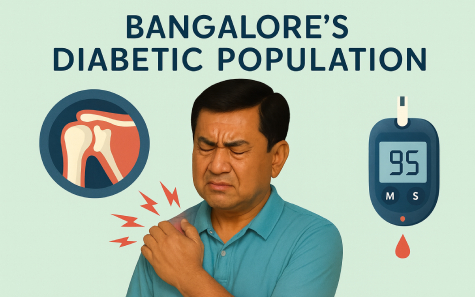
Why do so many people with diabetes in Bangalore struggle with shoulder stiffness that refuses to go away?
It’s a question I hear almost daily in my clinic — often from patients who thought their pain was due to age, posture, or overuse, only to discover that their diabetes was the real trigger.
Recent research shows that diabetics are two to four times more likely to develop Frozen Shoulder. In urban areas like Bengaluru — where diabetes rates are among the highest in India — Frozen Shoulder has quietly become one of the most disabling musculoskeletal complications.
As an orthopedic surgeon frequently treating Frozen Shoulder in Bangalore, I’ve seen firsthand how different, stubborn, and aggressive Frozen Shoulder can be in diabetic patients.
Let’s explore why — and how modern treatment, including arthroscopic capsular release, helps regain full movement much faster.
Why Diabetics Are at Higher Risk — The Science Behind the Stiffness?
Diabetes affects the smallest blood vessels and connective tissues throughout the body.
When sugar levels stay high for years:
- Collagen fibers inside the shoulder capsule stiffen
- The capsule thickens and tightens
- Inflammation becomes chronic
- Movement becomes painful and restricted
This process is called glycosylation, and it directly accelerates the severity of Frozen Shoulder.
That’s why in diabetics:
✔ Both shoulders can get affected
✔ Pain lasts longer
✔ Stiffness develops faster
✔ Recovery is slower
✔ Physiotherapy is often less effective
Why Frozen Shoulder Behaves Differently in Bangalore
Bangalore has one of India’s highest diabetes burdens due to:
- Sedentary desk jobs
- High stress
- Irregular meals
- Low physical activity
- Long commuting hours
Because of this lifestyle mix, diabetic patients here often develop musculoskeletal stiffness earlier and more aggressively.
For many, Frozen Shoulder becomes the first sign that blood sugar has been running high for too long.
Why Patients In Bangalore Choose Me – Dr. Ponnanna K.M
I’m Dr. Ponnanna K.M, Consultant Arthroscopy & Joint Replacement Surgeon, practicing at Opera Bone & Joint Clinic (Malleswaram) and Sparsh Superspeciality Hospital (Yeshwanthpur).
My journey includes:
- MS Orthopedics (RGUHS)
- DNB Orthopedics
- Multiple Australian Orthopaedic Association (AOA) Fellowships in Sydney
- Advanced training in shoulder arthroscopy, minimally invasive capsular release & reconstruction
- Global mentorship under leading experts like Dr. Peter Walker
I specialise in treating stiff shoulders, particularly in diabetic patients who struggle with prolonged pain and limited mobility.
At Opera Bone & Joint Clinic, patients receive calm, thoughtful consultations and complete in-house services including X-rays, fracture care, and physiotherapy.
At Sparsh Hospital, complex arthroscopic procedures and rehabilitation are performed with modern technology and expert teams.
The Real Reason Diabetic Frozen Shoulder Doesn’t Improve Quickly
In non-diabetics, Frozen Shoulder sometimes recovers naturally.
In diabetics, the capsule is much thicker, more inflamed, and more fibrotic.
This leads to:
- Poor response to physiotherapy
- Slower reduction in pain
- Severe restriction in rotation
- Higher risk of bilateral involvement
- Longer disease duration (often 12–36 months)
This is why many diabetic patients feel stuck even after months of therapy.
Myth vs. Fact: Special Edition for Diabetics
Myth 1: My shoulder will heal when my diabetes improves.
Fact: Better sugar control helps, but the frozen capsule will not loosen on its own.
Myth 2: Frozen Shoulder is a normal part of aging.
Fact: It is a complication of diabetes — not age.
Myth 3: Physiotherapy alone can reverse diabetic Frozen Shoulder.
Fact: When the capsule has hardened, therapy cannot stretch it open.
Myth 4: Surgery is risky for diabetic patients.
Fact: Arthroscopic capsular release is minimally invasive and highly safe in diabetics.
Myth 5: I must wait 1–2 years for relief.
Fact: Modern arthroscopy restores movement in 4–8 weeks.
Arthroscopic Capsular Release — Why It Works Exceptionally Well in Diabetics
Diabetic Frozen Shoulder responds poorly to conservative care — but beautifully to arthroscopic release.
Why:
- Thickened portions of the capsule are precisely cut
- Pressure on the joint reduces instantly
- Rotation improves immediately
- Post-op therapy works far more effectively
- Pain drops rapidly
This keyhole procedure takes 20–40 minutes and uses tiny incisions.
For diabetic patients who have struggled for months, this often feels like a breakthrough.
My Patient Reviews — Real Stories From Diabetics in Bangalore
⭐ 1. Chandra, 62, Rajajinagar
“My sugars were high and my shoulder wouldn’t move. After months of therapy, nothing changed. One month after arthroscopy, I felt like I got back 10 years of freedom.”
⭐ 2. Farida, 55, Yeshwanthpur
“I thought diabetes would complicate surgery, but Dr. Ponnanna explained every step. The recovery was smooth and painless.”
⭐ 3. Harish, 48, Malleshwaram
“I lived with stiffness for a year. After the release surgery, I could drive again in 3 weeks. It changed everything.”
Why I Follow a Different Treatment Strategy for Diabetics?
A diabetic Frozen Shoulder needs a diabetic-specific approach:
- Gentle physiotherapy (to avoid increasing inflammation)
- Steroid injections only when needed
- Precision arthroscopic release for advanced cases
- Controlled blood sugar optimisation during recovery
- Structured physiotherapy immediately after surgery
This approach has consistently delivered excellent outcomes.
FAQs — Diabetic Frozen Shoulder
1. Why do diabetics get Frozen Shoulder more often?
Due to chronic inflammation and collagen stiffening caused by high sugar levels.
2. Will surgery affect my diabetes?
No. Arthroscopic release is minimally invasive and safe.
3. How long does recovery take?
Most diabetic patients regain function in 4–8 weeks.
4. Will it affect the other shoulder?
Diabetics have a higher chance of bilateral involvement — early treatment reduces risk.
5. Is arthroscopy better than MUA for diabetics?
Yes. Arthroscopy is controlled, precise, and safer.
You Can Break the Diabetic–Stiff Shoulder Cycle
Frozen Shoulder may be more aggressive in diabetics —
but it doesn’t have to control your life.
With timely evaluation, advanced arthroscopy, and structured care, Frozen Shoulder in Bangalore can be treated quickly, safely, and effectively.
As I tell every diabetic patient:
“Your sugars may be high — but your shoulder mobility doesn’t have to be low. Relief is absolutely possible.”
📍 Clinics
Opera Bone & Joint Clinic
#14, Ground Floor, 4th Main, 6th Cross, Malleswaram — 560003
Sparsh Hospital
4/1, Tumkur Rd, Yeshwanthpur Industrial Area, Bengaluru — 560022