
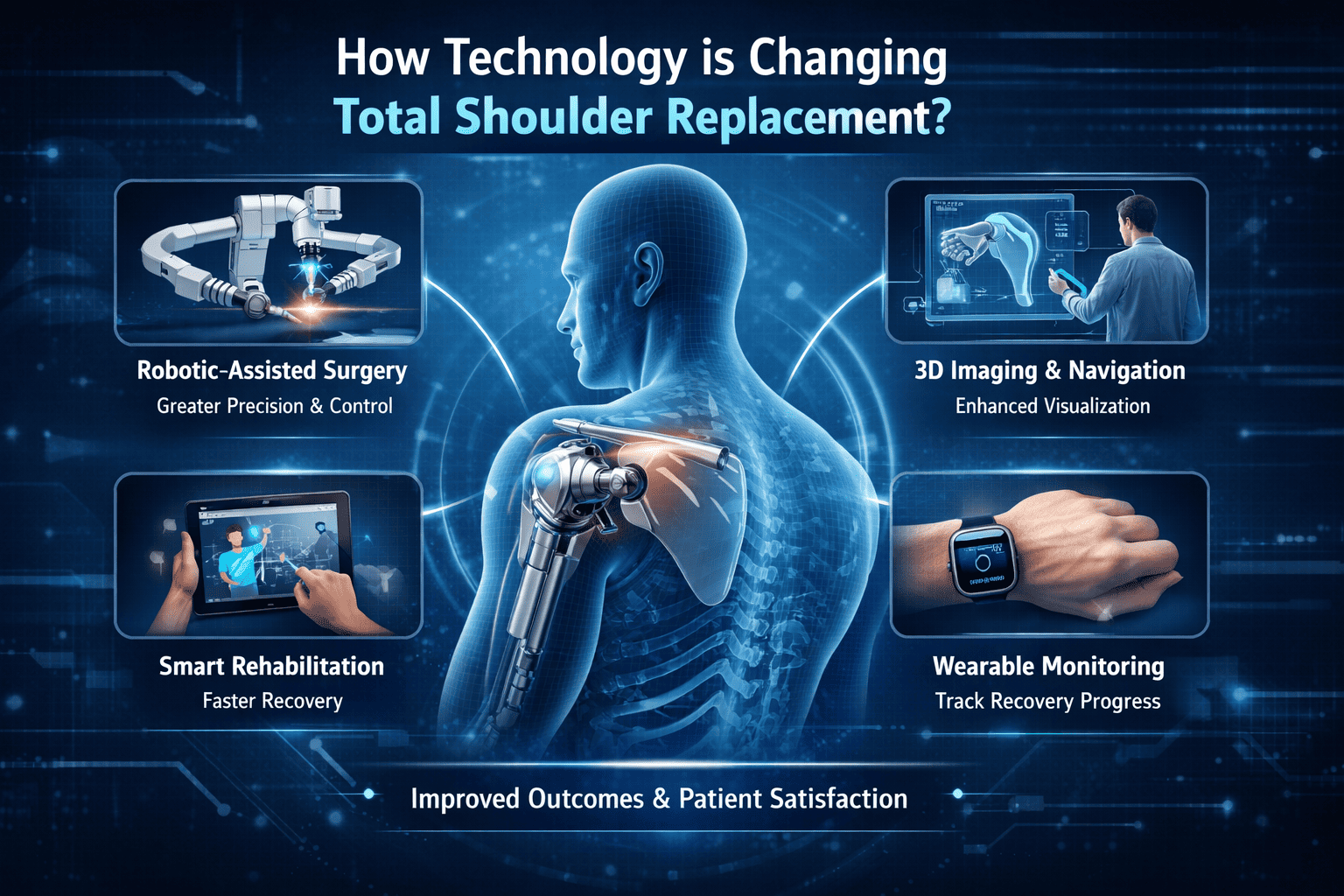
“In India, nearly 20% of people above the age of 55 suffer from moderate to severe shoulder arthritis, yet many continue living with the pain because they fear surgery or worry about recovery. What I want my patients to understand is simple—modern technology has revolutionized Total Shoulder Replacement. It is now far more precise, safer, and much easier to recover from than it was a decade ago.”
“I’m Dr. Ponnanna K.M, Consultant Arthroscopy & Joint Replacement Surgeon. Through my work in Pune, Bangalore, and Sydney, I’ve seen firsthand how digital planning, personalized surgical tools, and advanced implants have completely transformed outcomes. Today, my focus is on ensuring that patients feel informed, confident, and reassured through every step of their treatment.”
Understanding Modern Total Shoulder Replacement
Total Shoulder Replacement is one of the most effective treatments for advanced shoulder arthritis. Instead of simply replacing the joint surfaces, modern systems restore natural movement and dramatically reduce pain.
Patients who once struggled with daily activities—lifting, reaching, combing hair, or even sleeping comfortably—regain smooth, stable mobility with the new generation of implants.
This makes it a central component of effective Shoulder Arthritis Treatment, particularly for cases where pain and stiffness have been persistent for years.
Anatomic vs Reverse Shoulder Replacement: Pros & Cons
Choosing between the two depends on the rotator cuff condition and the severity of arthritis.
Anatomic Shoulder Replacement
This procedure maintains the shoulder’s natural mechanics and works best when the rotator cuff is healthy. It helps restore smooth, fluid movement and is often recommended for patients with moderate arthritis and intact soft tissues.
Reverse Shoulder Replacement
This option is preferred when patients have massive cuff tears or severe arthritis.
Benefits include:
- Improved stability
- Pain-free range of motion
- Better function for older patients
- Deltoid muscle takes over the lifting role
Reverse replacement is particularly helpful when traditional movement mechanics are no longer possible.
Why Many Patients Delay Surgery
Despite severe pain, many patients postpone surgery due to:
- Fear of long recovery
- Misunderstanding about the procedure
- Anxiety about losing arm strength
- Lack of awareness of modern minimally invasive techniques
Unfortunately, delaying treatment often worsens stiffness and reduces shoulder function, making daily life progressively harder.
The Power of 3D Pre-Operative Planning
3D digital planning is one of the most transformative advances in modern shoulder surgery.
It creates a virtual model of the patient’s shoulder, allowing precise evaluation of:
- Bone deformity
- Joint wear
- Implant size
- Ideal implant positioning
This significantly improves accuracy, reduces the risk of complications, and enhances implant longevity. It is especially valuable for complex arthritis or long-standing deformities.
Patient-Specific Instrumentation (PSI): A Game-Changer
PSI uses customized surgical guides created from the patient’s own scans. These guides help place the implant at the exact planned angle and depth.
Benefits include:
- Greater accuracy
- Shorter surgical duration
- Smaller incision
- Less tissue disruption
- Faster functional recovery
Together with 3D planning, PSI ensures results that are far more predictable than traditional methods.
Shoulder Replacement Surgery Cost Bangalore
The cost varies based on:
- Whether the implant is anatomic or reverse
- Use of 3D planning or PSI
- Hospital facilities
- Surgeon expertise
- Rehab requirements
For most patients, the investment brings lasting relief from severe pain and improves quality of life. Consulting the Best Shoulder Replacement Surgeon Bangalore helps identify the most appropriate approach depending on clinical need and budget.
Dr. Ponnanna’s Modern, Technology-Driven Shoulder Surgery Expertise
“My training across Bangalore, Pune, and Sydney helped me understand how shoulder replacement has shifted from a standard open procedure to a highly technological, precision-driven surgery. Every patient deserves clarity, accuracy, and confidence at every stage of their care.”
“During my Australian Orthopaedic Association fellowships, I worked with advanced 3D planning systems, patient-specific guides, and innovative implants. Seeing how personalized planning impacts recovery made me firmly believe that technology is not optional—it is essential for the best outcomes.”
“Today, whether I’m performing an anatomic or reverse replacement, my goal remains the same: to eliminate pain, rebuild strength, and help every patient return to daily life with full functional confidence. Shoulder arthritis can be disabling, but with modern techniques, recovery is faster and far more predictable.”
Frequently Asked Questions
1. Is Total Shoulder Replacement very painful?
With modern anesthesia and minimally invasive techniques, recovery is far smoother than before.
2. Which is better — anatomic or reverse replacement?
It depends on rotator cuff health and arthritis severity. Each has specific advantages.
3. How long do shoulder implants last?
Modern implants, especially when placed using 3D planning, may last 15–20+ years.
4. Will I need physiotherapy after surgery?
Yes, physiotherapy is crucial for regaining strength and achieving long-term mobility.
5. When can I return to office work?
Most patients return to desk work within 2–3 weeks.
Patient Reviews
Rakesh N.
“After years of debilitating pain, Dr. Ponnanna K.M gave me back full movement with shoulder replacement.”
Suma P.
“I had severe arthritis with cuff tear. Reverse shoulder replacement changed my life.”
Joseph A.
“The 3D planning helped me understand the problem clearly. My recovery was better than expected.”
Technology has reshaped the landscape of Total Shoulder Replacement, offering patients safer procedures, faster recovery, and more durable results. Innovations like 3D planning and patient-specific instrumentation ensure that each surgery is tailored to individual anatomy, greatly improving outcomes.
For those living with persistent pain, stiffness, or severe arthritis, modern surgical care opens the door to a pain-free, functional life. Consulting an experienced specialist is the first step toward long-term shoulder health.
Dr. Ponnanna K.M — Contact
Opera Bone and Joint Clinic
#14, Ground Floor, 4th Main, 6th Cross, Malleswaram, Bangalore – 560003
📞 89515 45276